The Pendulum as a fixed-point motif
Foucault's PendulumJacopo Belbo’s account of Foucault’s Pendulum makes the instrument a fixed-point motif: it offers an image of certainty in a moving universe, but cannot tell anyone where certainty should be found. First encountered by Casaubon through Belbo’s description and then seen for himself, the Pendulum is at once a physical demonstration, a possible consolation for unbelievers, and a warning that even an apparently objective point of reference acquires meaning through human choice.
The instrument and its setting
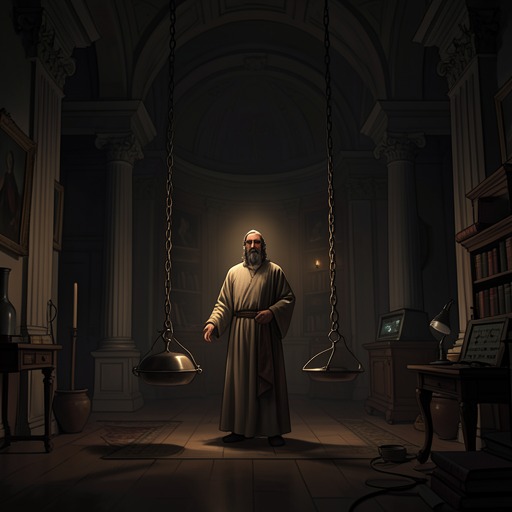
Belbo introduces the Pendulum while discussing places Casaubon should visit for his research. He mentions the science museum in Munich and the Conservatoire des Arts et Métiers in Paris, adding that he would return to the latter if he had time. The institution’s setting gives the machine its unsettling force: Belbo calls it “The triumph of the machine, housed in a Gothic church...” Its scientific apparatus stands inside a former religious space, bringing machinery and sacred atmosphere together without resolving the tension between them.
Belbo names it simply as Foucault’s Pendulum, then describes it to Casaubon before Casaubon sees it in person. The account shapes the later encounter: Casaubon recognizes that Belbo may have prepared him to see the object as significant, though his own response apparently falls short of expectation. Belbo regards him as though a visitor to the Sistine Chapel had asked whether that was all. The contrast establishes that the Pendulum’s importance does not reside only in its visible mechanism; expectation and interpretation are already part of its effect.
Motion, the fixed point, and belief
Belbo explains the Pendulum through the contrast between its apparently stable suspension point and the rotating Earth beneath it. To someone looking at it, everything else seems to move while the point above remains fixed. He suggests that this experience can offer a route back to God for people without faith, precisely because it need not challenge their unbelief: the fixed point can function as a “null pole,” a point of orientation that does not require a fully articulated religious commitment. For people of Belbo’s generation, disappointed by the collapse of successive political and collective certainties, that apparent stability can be comforting.
The comfort, however, is inseparable from a limit. Belbo calls the Pendulum a “false prophet”: although it seems to reveal the one fixed point in the cosmos, it can be detached from the ceiling of the Conservatoire and hung in a brothel without ceasing to work. He notes that other Pendulums exist in New York’s United Nations building and in San Francisco’s science museum. Its operation is therefore not evidence that the Conservatoire itself occupies a uniquely privileged position. Wherever it is suspended, the Earth rotates beneath it; any location can serve as the point from which the demonstration is observed.
Belbo draws the motif’s broadest implication from that portability: “Every point of the universe is a fixed point: all you have to do is hang the Pendulum from it.” The instrument seems to promise access to the infinite, but it leaves the placement of the infinite to the observer. Its demonstration is real, while the choice of what that demonstration means remains open. The object does not abolish the need for belief or judgment; it relocates that responsibility to the person who selects a point of reference.
The search for the right place
For Belbo, this unresolved choice is not merely a problem of scientific interpretation. The feeling produced by the Pendulum, he says, is that one has spent a lifetime hanging it in different places, where it never seemed to work, until it appears to work at the Conservatoire. The apparent discovery of the right place follows a long search, but the instrument gives no independent guarantee that the chosen setting is uniquely right. The Gothic church supplies atmosphere, and atmosphere makes the experience convincing; neither fact proves that the location has cosmic privilege.
Belbo wonders whether there are special places in the universe, whether the right one might be close at hand but unrecognized, and whether recognition might require belief. These possibilities keep the motif suspended between material explanation and a spiritual reading. The Pendulum can be understood as a reproducible scientific instrument, yet the experience of seeing it in a church invites the observer to treat it as more than that. The passage does not settle the invitation into proof. Instead, it makes the desire for a privileged point—and the power of a setting to make one feel privileged—part of the subject.
Meaning within the conversation
The Pendulum’s fixed point also gives Belbo a way to describe the loss of historical certainties. In his account, Fascism had offered a fixed point even to children who experienced it as adventure; the Resistance became another, especially for those who watched from outside and transformed it into a rite of passage. Later, some found certainty in God, others in the working class, and many in both. Belbo contrasts those earlier orientations with the present, where workers remain but the working class no longer seems to exist as a coherent political force. The Pendulum condenses the pattern: a fixed point can orient a life, but historical and collective reference points can disappear or prove inadequate.
Belbo’s explanation is directed at Casaubon, whom he calls innocent for having run away rather than thrown stones, completed his degree, and not shot anyone. He says that seeing the Pendulum the previous year helped him understand almost everything, but immediately qualifies the claim by insisting that the instrument is a false prophet. The exchange thus turns the object into an interpretive device within their conversation, not a final answer to it. After describing a lifetime of searching for a place where the Pendulum seems to work, Belbo breaks off and moves on to the practical business of introducing Casaubon to Signor Garamond. The abrupt return to employment leaves the motif’s central decision unresolved: the instrument can offer a fixed point, but it cannot choose one on anyone’s behalf.